Congestion isn't a Transportation Problem, It's a Car Problem
Being stuck in traffic sucks. It’s a topic that comes up frequently in social settings, but it’s also been written about in a number of journals. One study found that “the longer the commute, the lower the satisfaction with work and life; the length of commuting can also cause damage to health” which is a genuine problem to solve! Here in Denver, people stuck in congestion are literally wasting their lives away on roads and highways: Denverites spend 76 hours a year stuck in traffic, which is somewhat above the 63 hours a year average for the US, and it’s getting worse.
If you go to a neighborhood or city planning meeting pretty much anywhere in the United States, you’ll likely hear a lot about traffic and congestion. Often, one of the main reasons you’ll hear people opposing new housing is that it will add to traffic and parking issues in the neighborhood.1 Rightfully, people are concerned about transportation and how they’ll navigate their neighborhood or city.
It’s rational to want to prevent commute times from getting worse, but opposing new development is an awful way to improve commute times. Congestion results from inefficient uses of space, whether that inefficient land use or cars. Cars are, fundamentally, a geometry problem. You can’t fix the fact that a two ton metal box is a pretty terrible way to carry 1.7 people. Sure, there are marginal ways to increase the efficiency of cars to reduce congestion without creating major inefficiencies in land use - roundabouts can be a good option, for instance. But other car efficiency improvements, like cloverleaves, come at the cost of other things we want, like housing, precisely because car infrastructure is inherently inefficient. Adding lanes to a roadway may marginally increase total throughput of vehicles in a corridor but, due to induced demand, the individual experience of traffic will quickly become identical to before the expansion. This is all illustrative of the fact that the solution to inefficient uses of space is not additional inefficient uses of space!
Congestion isn’t a transportation problem, it’s a car problem.
Planners should be agnostic as to what mode people are using and mostly focused on what moves people efficiently, and non-car methods of transportation are significantly more efficient at moving people than cars and trucks. Public transportation, for instance, can be an order of magnitude more efficient than cars. Bikes and walking are highly efficient, especially when paired with public transportation. Gifs like the one below are a common on the internet, and effectively show how much smarter it is to dedicate space to active- and public-transportation instead of private automobiles.
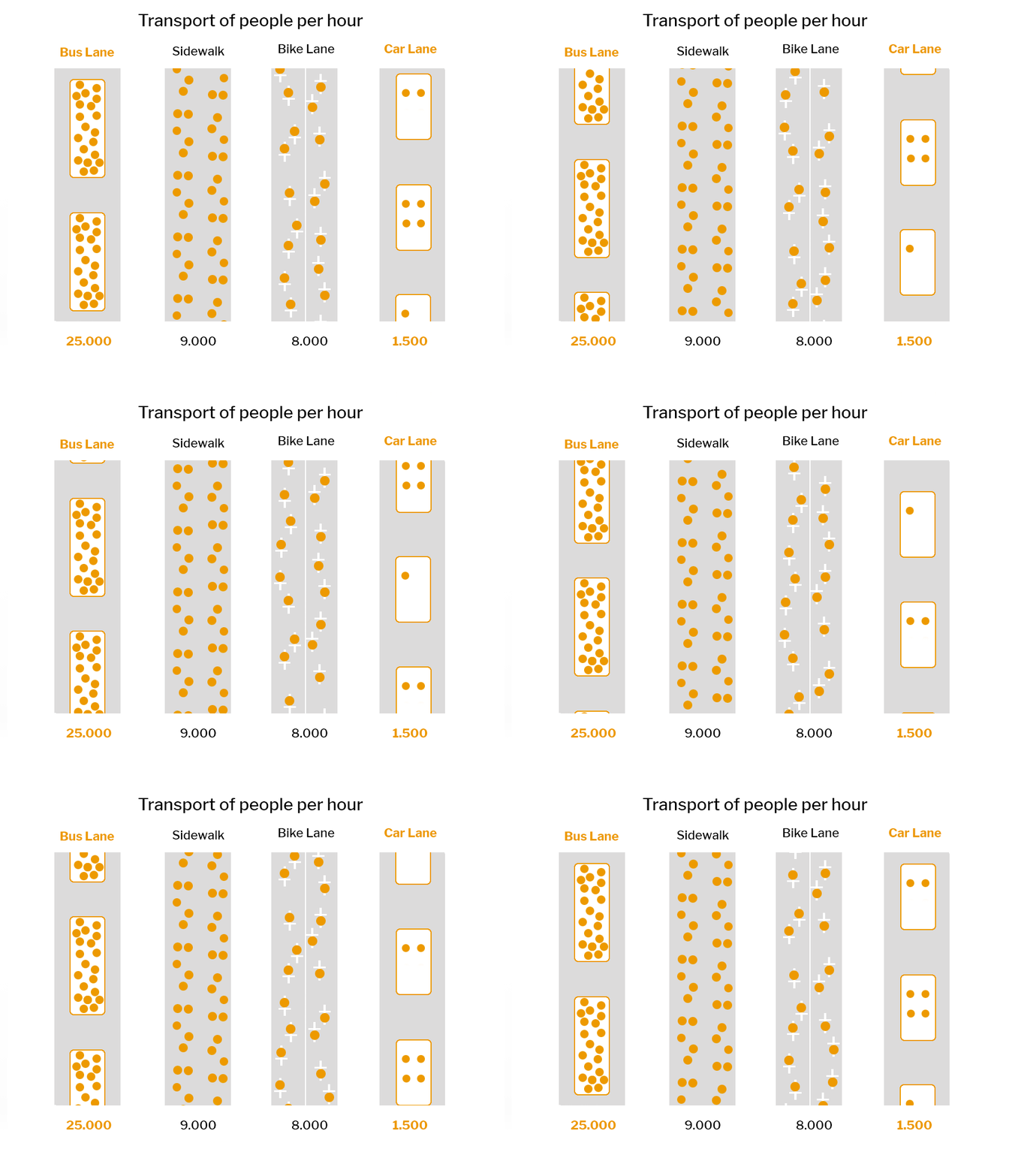
The real solution to inefficiency is efficiency improvements, and transforming roads from car-dominated to bus- or bike-dominated will dramatically improve throughput of a given corridor.
But it won’t eliminate congestion. The lanes that remain for cars will continue to be clogged by cars, and the people who choose to remain in those cars will still loudly complain about the genuinely terrible experience of sitting around in a car waiting for other cars to move. But planners shouldn’t pay attention to that complaining. A city should not focus on how to move cars through a given area, it should focus on how to move people through a given area. To the question of how to efficiently move people, bikes, buses, sidewalks, and rail are always going to be the answer.